 Dev Patnaik
Leadership shows up not in the play call, but in how leaders help teams understand what the moment asks of them.
This Sunday, more than 130 million people will tune in to watch the Super Bowl, the most-watched television event of the year. The Seattle Seahawks will face the New England Patriots in a rematch of their 2015 battle. Of course, a lot has changed in the decade since they last faced off. Both teams experienced the departure of their star quarterbacks and championship coaches. For both teams, this Super Bowl represents a hard-fought return to greatness.
Don’t worry if you don’t follow football closely. Part of the Super Bowl’s success is its ability to appeal to different audiences. While some people will be watching for the game itself, others will just be there for the party. Some viewers will drift in and out of the room, timing their attention to the commercial breaks. For them, the Super Bowl is the most scrutinized advertising showcase in the world. Still others will tune out until the halftime show. All of these people will be watching the same game. They just won’t be watching the same thing.
I care about strategy and leadership, and football is an amazing crucible to learn about both. Half of what matters is what I see on Sunday. The other half won’t reveal itself until a day or two later.
For years, the NFL has been wiring up players and coaches with microphones to capture the game as they experience it on the field. Fans can go online a few days later to hear what players were saying during the game. So, this Tuesday, I’ll be listening in. And I’ll be listening for leadership.
The Last Big Game
One of the greatest examples of what an audio track can reveal about strategy and leadership happened the last time that Seattle and New England met, back in Super Bowl XLIX.
The Seattle Seahawks arrived as the defending champions, having won the year before. They had the strongest defense in the league, and a sense that they were living in their golden era. On the sideline, Coach Pete Carroll set the tone: relentlessly optimistic, fiercely competitive, and deeply committed to a culture that prized belief as much as execution. Quarterback Russell Wilson was in the early ascent of his career, playing with a mix of poise and improvisational calm that made pressure feel optional.
The New England Patriots arrived with a different kind of gravity. They were already a dynasty, shaped by years of success at the highest level. Patriots quarterback Tom Brady had made it to five Super Bowls and won three of them. Still, the Patriots had lost their last two championships. Brady was now in his late thirties, and there was open speculation about whether his best days were behind him. That combination of experience and uncertainty gave the Patriots a different kind of pressure as they took the field.
That Sunday, 114 million people watched as the drama unfolded. Brady threw a touchdown pass to Brandon LaFell, giving New England an early lead. Wilson matched it with a touchdown to wide receiver Chris Matthews. Brady tried again, and this time his pass was intercepted. Back and forth it went, with the teams tied 14–14 at halftime.
The third quarter belonged to Seattle. A field goal and a bruising touchdown drive put them ahead by ten. The energy in the stadium slowly tilted against the Patriots. After all, no team had ever come back from a ten-point deficit in the second half to win a Super Bowl.
Calmly, methodically, Tom Brady got to work. In the fourth quarter, he led the Patriots to drive down the field and score a touchdown. Then he did it again. New England now led Seattle 28–24.
But Russell Wilson wasn’t finished. He moved the offense down the field, making a miraculous pass to Jermaine Kearse that kept the drive alive. With twenty seconds left to play, the Seahawks reached the one-yard line. Close enough to reach, close enough to win. The air in the stadium tightened. Tom Brady watched from the sidelines as the Patriots’ defense got into position.
What happened next has been replayed, debated, and dissected for more than a decade.
On second down, with one timeout remaining, Seattle was ready to run the ball in. Instead, they chose to throw it. And that’s when everything collapsed. The pass was intercepted by Patriots cornerback Malcolm Butler. The game was over. New England had won.
The Strategy Challenge
Within hours, the decision to pass was being framed as one of the worst calls in Super Bowl history. Over time, that judgment hardened into consensus. Football historians and sportswriters still describe the interception as one of the greatest plays the game has ever seen. The decision that Coach Carroll and Russell Wilson made to pass the ball is often remembered as a catastrophic error.
But the play has also surfaced in conversations about strategy. Beyond sports radio and fan forums, the Seahawks’ play has appeared in quantitative analyses discussions about decision-making under uncertainty. One notable example came from Communications of the Association of Computing Machinery, the flagship publication of the computing and technical community, which examined the decision through the lens of computational thinking and game logic.
ACM’s argument is simple. Seattle was operating under severe constraints: limited time, limited timeouts, and a defense designed to force predictability. A running play that failed would keep the clock moving and collapse future options. A short pass, even if incomplete, would stop the clock and preserve flexibility on subsequent downs.
Looked at this way, the choice wasn’t reckless. It was an attempt to manage time and preserve optionality. The decision was designed around process rather than prophecy, shaped by what could be controlled in the moment rather than by how the story would sound afterward.
That’s an important lesson about strategy: decisions are rarely made with perfect information. They’re made inside systems that impose constraints and tradeoffs. Judgment lives in how leaders navigate those constraints, not in how outcomes eventually arrange themselves. No one would have bothered to question Carroll and Wilson’s decision if Butler hadn’t made that interception.
Of course, that’s only half the story. The other half is about leadership. And that showed up in the microphones.
The Leadership Challenge
After the game, several critics rightly pointed out that, despite their victory, the Patriots’ performance had been less than perfect. Brady threw two interceptions. The Patriots entered the fourth quarter ten points behind. Some even said that Brady’s team had saved him.
Those critics didn’t listen to the mics.
The recorded conversations demonstrate a fundamentally different role that Russell Wilson and Tom Brady played for their teams.
Wilson was a great quarterback. By and large, his words to his teammates were either general encouragement, like “Let’s go!” or standard quarterback instructions with the intricate jargon that professional football players are expected to know. Things like “Strong right zoom zip fourteen force second color!”
Brady’s messages were more about his feelings toward his teammates. Things like “I love you guys!” and “You’re the best!” When the Patriots started to fall behind in the second half, his messages were things like, “Let’s go, boys! This is our time!” He told them he was proud to play alongside them. He told them how lucky he was to be there with them. And he told them he believed in them.
And just before he led the Patriots to their touchdown drive in the fourth quarter, Brady turned to his team and said confidently, “We need a big championship drive. That’s what we need. Let’s go, boys. We do it all the time…”
That difference in messaging reflected the difference in stature that Brady held with his team compared to Wilson. Brady was their quarterback, but he was also their senior. While Tom Brady had been to five Super Bowls, his last win had been in 2005, a decade earlier. Most of his teammates were younger players who had never been to a championship game, much less won one. And what they needed was his confidence in them.
Even Malcolm Butler, who made that winning interception, was just in his rookie season. He was 25 years old. Brady was 37. By contrast, Russell Wilson was playing with a group of his peers, most of whom had been with him when they won the Super Bowl the previous year. Tom Brady wasn’t just their quarterback. He was their senior leader.
That difference showed up in how Wilson and Brady rallied their teams before the game. In their pregame huddle, Wilson gave his team a strong but standard pep talk.
“We’re prepared better than anybody else. We’re prepared for this moment right here, right now. Let’s go win this thing! We came here for one goal. One mission. And let’s go get it, man. Together on three…one, two, three!”
Brady’s huddle had an entirely different energy, something akin to Henry V’s speech at the Battle of Agincourt.
“It started 7 or 8 months ago, right? All for this moment. It’s about honor! It’s about respect! If we win this game, you’re honored! Your kids are honored! Your families are honored! Win on three…one, two, three!”
Brady wasn’t giving a pep talk. He was declaring a call to arms. There is no doubt that Tom Brady and the Patriots’ offense stumbled in the face of the best defensive line in football. But it’s also true that Brady’s leadership helped him overcome that challenge. Sure, his team might have saved him. But he set up his team for the save.
The lesson is that leadership in moments like this rarely takes the form of commands. It shows up as a reminder. A reminder of what the work is for, who it’s for, and why it matters enough to stay steady when everything is on the line. When leaders do that well, they create something stronger than action. They create devotion. The kind that allows a team to make a collective leap and take a risk together.
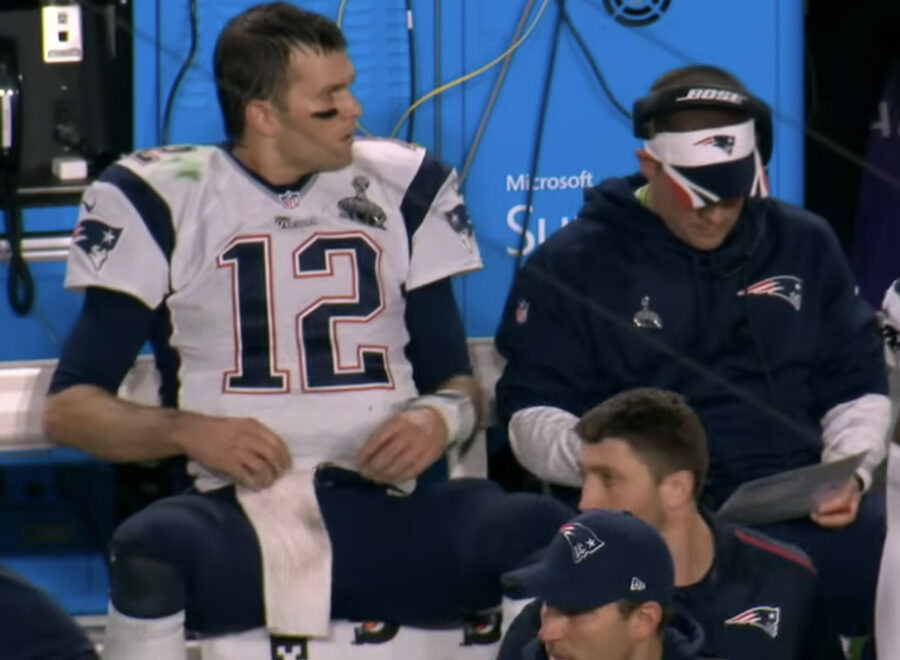
Still, there is one moment on the recording that was out of character for Tom Brady. It was after he threw an interception. Frustrated, he went back to the bench and started to stew on it. His coach, Bill Belichick, sat down beside him to discuss their next offensive strategy. Brady mumbled, “That was stupid…”
“Hey!” Belichick said firmly. “Let it go.” Even great leaders need great coaches, too.
Listening for the Next Generation
Today, all of those figures have moved on. Brady. Belichick. Wilson. Carroll. The architects of that earlier era are gone, and this Super Bowl belongs to a different generation. New quarterbacks. New coaches. New assumptions about strategy, culture, and what leadership looks like under pressure.
We’ll learn some of what that means on Sunday when we watch how the game unfolds moment by moment. And we’ll learn more on Tuesday, when the microphone recordings are revealed and the thinking behind those moments becomes audible.
Future-focused leadership is never about one play, one game, or even one season. It’s about a commitment to the long term. Tom Brady went on to play in a record ten Super Bowls, winning seven of them. What mattered most was the discipline to keep preparing, the patience to keep investing, and the steadiness to stay focused on what matters most, year after year.